one ink, one screen
Spot color separation, free and in your browser
* Free to use — the editor runs in your browser, and nothing is uploaded unless you start a server step: the AI tools, or upscaling a photograph (logos and flat artwork are enlarged on your device). A free account (Google, Apple or an emailed code — no card) is needed to download the finished file, and comes with credits for the server-side tools.
Spot color is most of the job list: logos, lettering, band merch, flat illustration. Load the art, set the ink count, and every pixel of each ink lands on its own plate — wherever in the design it appears. Free, no account, and it never leaves your machine.
Separate a design nowWhat a spot separation has to get right
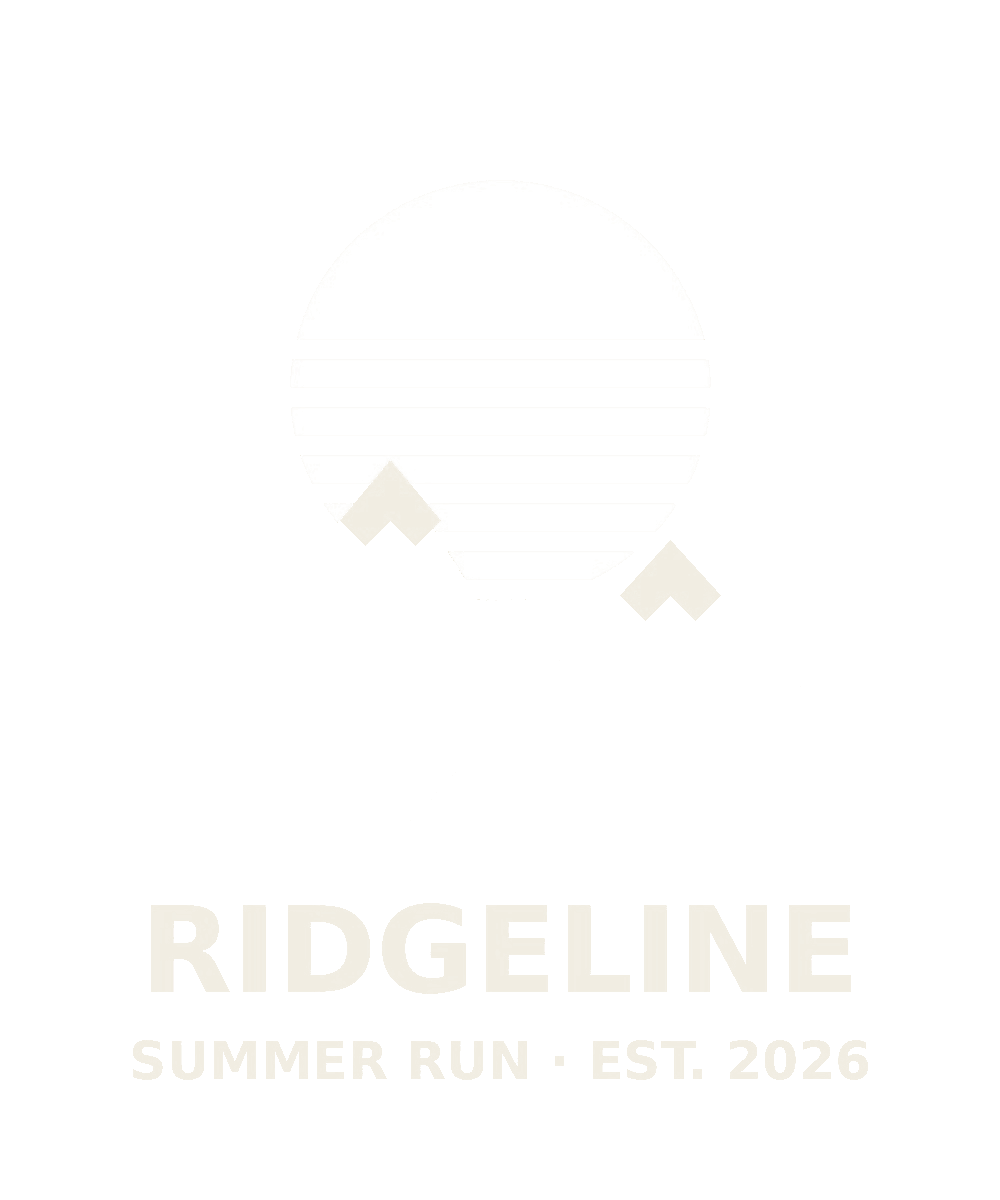
A spot separation is one plate per ink, and the rule that matters is that a plate is defined by color, not by shape. A single cream ink might appear in eleven letters of a wordmark, two snowcaps and a scattering of highlights — that is one screen, printed once, so it has to be one plate. Tools that separate by connected region hand you eleven plates and a headache, and tools that filter small regions by area quietly drop the lettering entirely. The separator here clusters in LAB space using perceptual color distance, so inks are grouped the way a printer groups them and small shapes of a known ink stay with their ink.
Why grouping by colour and not by shape is the whole game
This is the failure that separates working tools from demos, so it is worth being concrete about — and the plate below is the concrete version, exported from the live editor today. Take a wordmark: eleven letters in cream, sitting above a mountain with two cream snowcaps and a scatter of cream highlights in the trees. That is fourteen or more disconnected shapes and exactly one screen — one ink, mixed once, burned once, printed once. A separator that walks connected regions hands you fourteen plates, and now you are merging them by hand and hoping you did not miss the small one. Worse are the tools that filter regions by pixel area to keep the plate count down: those quietly delete the lettering, because a letterform at print resolution is a small region and the algorithm cannot tell the difference between a serif and a speck of JPEG noise. You find out at the light table. Grouping in colour space instead means the question asked of every pixel is "which ink is this?" rather than "which blob is this?", and the answer is the same for a 4,000-pixel mountain and a 40-pixel highlight of the same cream. Clustering here happens in LAB space using perceptual distance, so two colours that look the same distance apart to your eye are the same distance apart to the maths — which is not true in RGB, where a fixed numeric step is a huge shift in some parts of the space and invisible in others.
What tolerance actually decides
Ink count sets how many screens you are willing to burn — 2 to 12, most spot jobs landing at 2 to 6. Tolerance is the more interesting control: it sets how far a pixel may drift from an ink centre before it is treated as evidence of a different ink. Set it too tight on a file that has been through JPEG compression and every flat area fragments, because compression does not store flat colour as flat — an 8-bit fill that was one value on the designer's screen arrives as a cloud of values a few steps wide, and a tight tolerance reads that cloud as three inks that all look identical in the preview. Set it too loose and two colours you meant to keep apart collapse: a navy and a black that are genuinely different inks in your drawer merge into one plate, and the design loses its depth. The practical method is to separate high and merge down. Run at eight inks, look at the plates, and merge the ones that are the same ink in the real world — merging is instant and free, and unmerging is just a re-separate, whereas discovering at the press that two plates should have been one costs you a screen. The ink list is fully editable while you do it: merge, rename a plate from a hex code to the ink you will actually mix, reorder the print sequence, delete a plate and let the rest absorb it, and check every one in per-plate preview before you commit. There is no ink library and no PMS lookup here: a plate arrives named by its hex value and you type in the ink you are actually going to mix, which is the name that then lands in the PSD, the ORA and the file names.
The anti-aliased edge between two inks
Every edge in a raster design is a lie told in a few pixels. Where cream meets navy, the renderer wrote a ramp of blended values so the edge looks smooth on screen, and none of those intermediate values is an ink you own. A naive separator treats that ramp as evidence of new colours and gives you a phantom plate that is nothing but a one-pixel outline tracing every shape in the design — which looks almost plausible in a layer panel and is unprintable. Here blended pixels are assigned to whichever ink they are perceptually closest to, so the ramp splits down the middle and each half joins its parent plate. That is the right answer for screen printing for a reason beyond tidiness: a screen prints ink or no ink, so an edge pixel has to commit to one side regardless, and letting it commit to its nearest ink is the choice that keeps the edge where the designer drew it. Two things to know about the result. First, adjacent plates now butt against each other exactly, and any misregistration shows garment in the seam — which is what trapping is for, and it is part of the paid render. Second, on a badly compressed file the ramp is wider and noisier than the designer intended, and tolerance is the control for that — raise it so the noise collapses into its parent ink instead of spawning phantom plates, and refine anything left over with the brush before export. What you should not do is chase a perfect edge in the separator when the source JPEG never had one.
Free, client-side, and not uploaded
Spot separation runs entirely in your browser. There is no upload, no account, no queue, and no network call at all during separation — your customer's artwork is never transmitted anywhere, which you can confirm by watching the browser's network tab do nothing. Export as per-ink transparent PNGs, a numbered ZIP in stacking order, or an OpenRaster file for GIMP or Krita, all unlimited.
Two PSDs, both free, and the second one is the interesting one
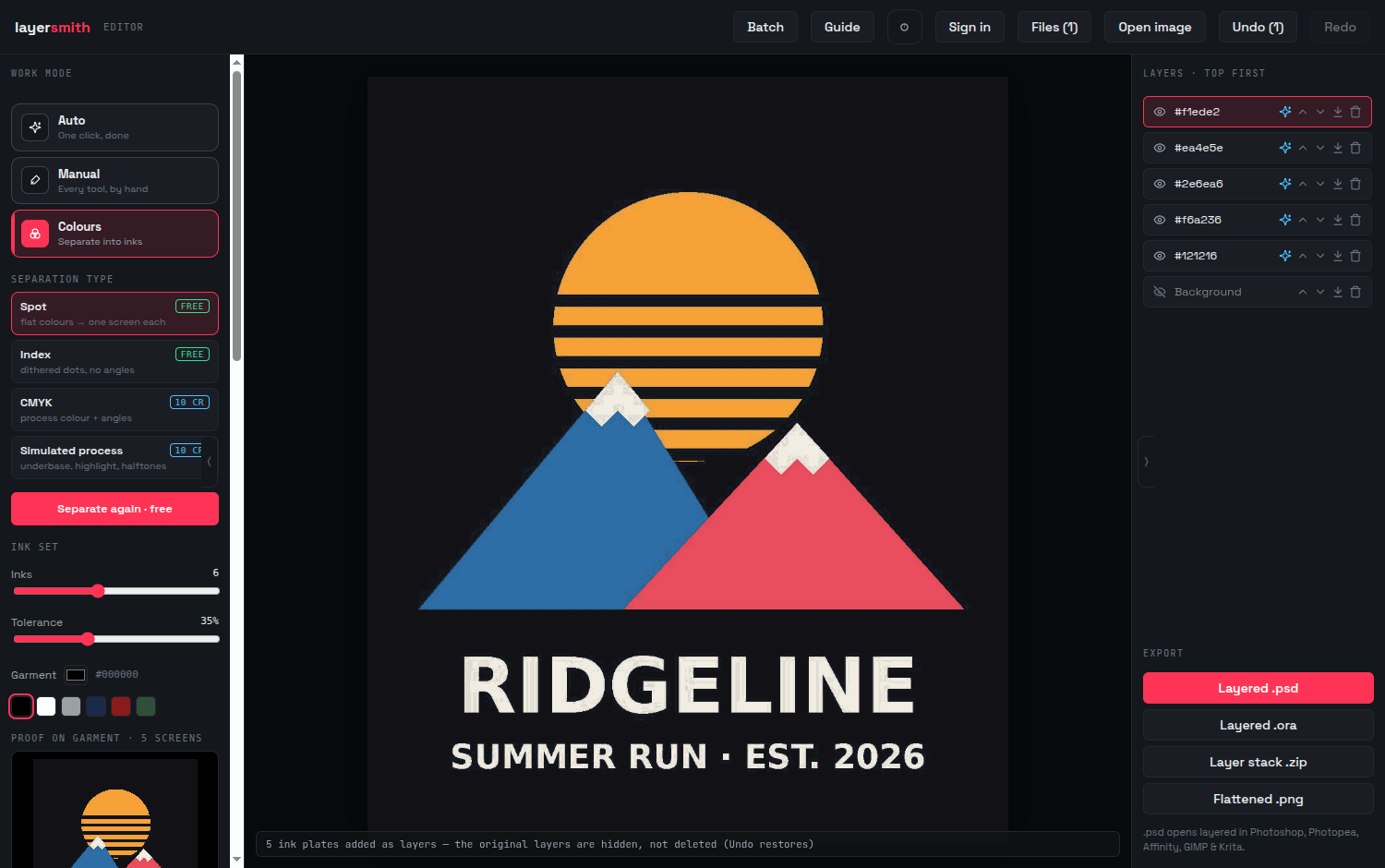
The layered PSD is the everyday hand-off: one named layer per ink, every plate written at the full canvas size of the original so they stack back up in register. The multichannel PSD is the one a separator actually wants. It carries one real Photoshop spot channel per ink, each with its ink colour and the name you gave it attached to the channel itself, written at the physical DPI implied by the print width you set — so Photoshop opens it at the right physical size rather than guessing. The garment base is deliberately left out, because the substrate is not a screen and including it would hand your shop an extra one to burn. Both exports are written in your browser and both count against the same allowance: one PSD export a day on a free account, uncapped on a monthly plan, and 3 credits each beyond that. Quantity is capped; quality is not, at any tier. Worth saying plainly because it is unusual — the desktop packages charge $229 to $399 for spot-channel output, and here it is the free half. And it has been checked by something other than our own writer: the multichannel file from the separation shown on this page was read back with psd-tools, an independent open-source reader, which reported four real spot channels named exactly #f6a236, #2e6ea6, #ea4e5e and #f1ede2, in colour mode 7 (multichannel), 8-bit, RLE compressed, with image resources 1005, 1006, 1077 and 1060, and the garment base correctly absent. Photoshop has not opened it yet, so we are not going to say it has.
When you want the print math on top
Separation is one half of a press-ready file; the other half is print math, and that is the paid render: per-ink choke and spread, trapping between adjacent inks, a choked underbase on dark garments, a separate highlight white printed last, dot-gain compensation, registration marks, halftone screening if a plate needs tone, vector plates, and 1-bit film at your chosen DPI. That render is 10 credits per image, and for 24 hours afterwards you can re-render the same image as often as you like, free, for 24 hours — long enough to adjust a choke value five times, print a test, and come back to it after lunch.
Where spot separation is the wrong tool
Spot is for flat and mostly-flat art. Point it at a full-tonal photograph and you will get a posterized approximation, because a photograph does not have discrete inks in it. For photographs you want index separation (posterize plus dither, no halftone angles to worry about) or simulated process (tonal channels, halftoned, underbase, highlight white). Both are one tab away, and both start from the same clustering pass you already ran.
Frequently asked
Is spot separation actually free?
Yes. It runs on your hardware, so it costs us nothing and we charge nothing: unlimited separations, unlimited PNG/ZIP/ORA export, and one PSD export a day with a free account — layered or multichannel with real spot channels, your choice — all at full quality with no watermark. The paid render is the server-side print math (choke, trap, underbase, halftone, dot gain, registration marks, vector plates, 1-bit film) at 10 credits per image.
How many inks can it separate?
Up to 12 in one pass. You can also merge inks afterwards, so a common workflow is to separate at 8, look at the plates, and merge down to the 5 you are actually going to burn.
What happens to anti-aliased edges between two inks?
Blended edge pixels are assigned to their nearest ink by perceptual distance rather than becoming stray plates of their own. Tolerance controls how aggressive that is, and you can refine any plate with the brush before export.
Does my artwork get uploaded?
Not for spot separation. Clustering, the ink list, per-plate preview and every export run in your browser and make no network call. Only the optional paid print-ready render sends the image to a server, and that copy is deleted within 24 hours.
Will the plates line up in Photoshop?
Yes — every plate is written at the full canvas size of your original, in register, so layering them back up reproduces the design exactly. The multichannel PSD goes further and writes each plate as a real spot channel carrying its ink colour and name, at the physical DPI implied by your print width.
Keep reading
Free online color separationIndex separation vs simulated processWhite underbase for dark garmentsWhat separation services charge per designHalftones: lpi, angles, film outputRelated
Index color separation, and when to choose it over simulated processSimulated process color separation, with the override you will needCMYK separation for screen printingHalftones for screen printing: lpi, angles, dot shape, film outputHow to create a white underbase for dark garmentsRaster to vector for screen printing: turning a customer JPEG into platesAn UltraSeps alternative that does not sit inside PhotoshopA Separation Studio alternative with no annual bill and no trial clock